Chemical puzzles and retro charm in Atomix
Atomix is a tile-based puzzle game developed by Softouch Productions and published by Thalion Software, set in a playful, laboratory-themed world where your goal is to build molecules from scattered atoms. Released at the dawn of the 1990s home-computer boom, it captured the spirit of that era: simple rules, tight design, and an emphasis on pure thinking over reflexes. Instead of action or flashy effects, Atomix offers carefully crafted levels that reward planning, foresight, and the satisfaction of finally seeing a molecule click into place. Its concept is rooted in basic chemistry, yet it never feels like homework; the game takes scientific ideas and turns them into a friendly, abstract puzzle playground.
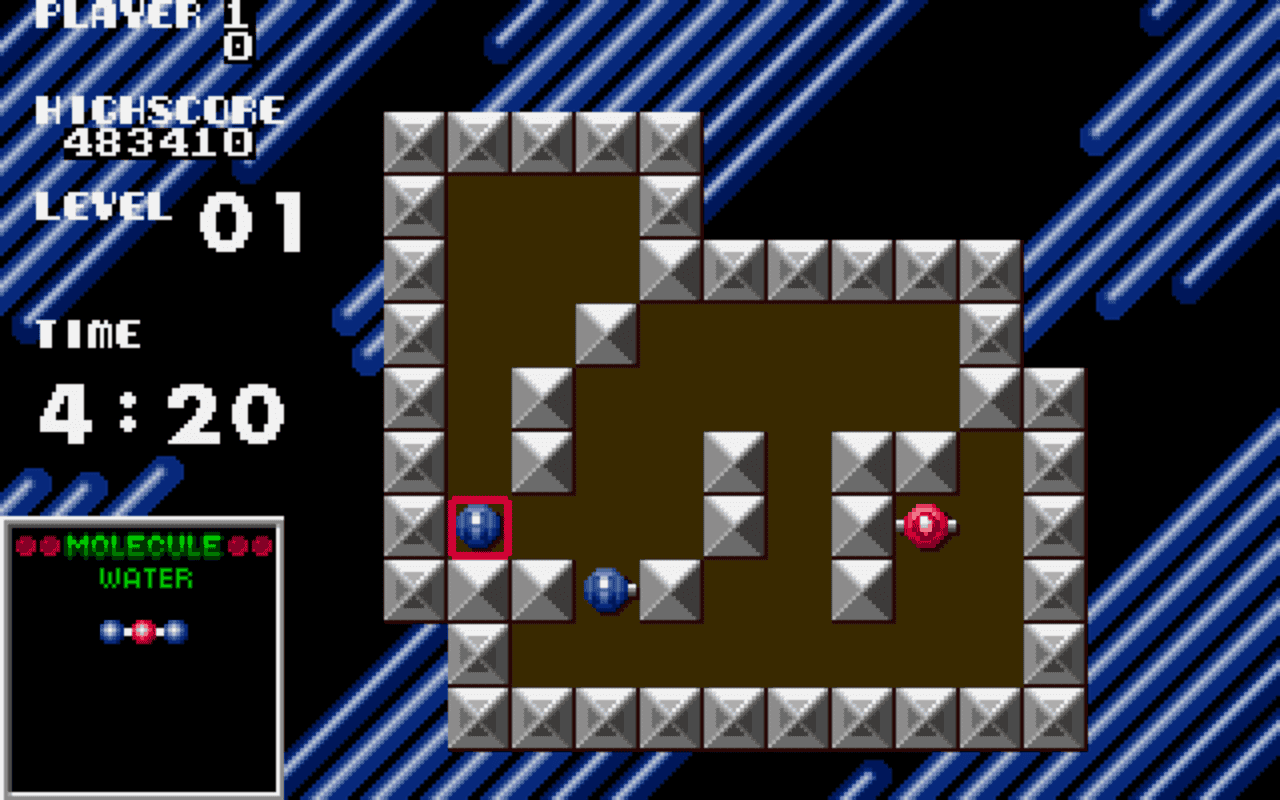
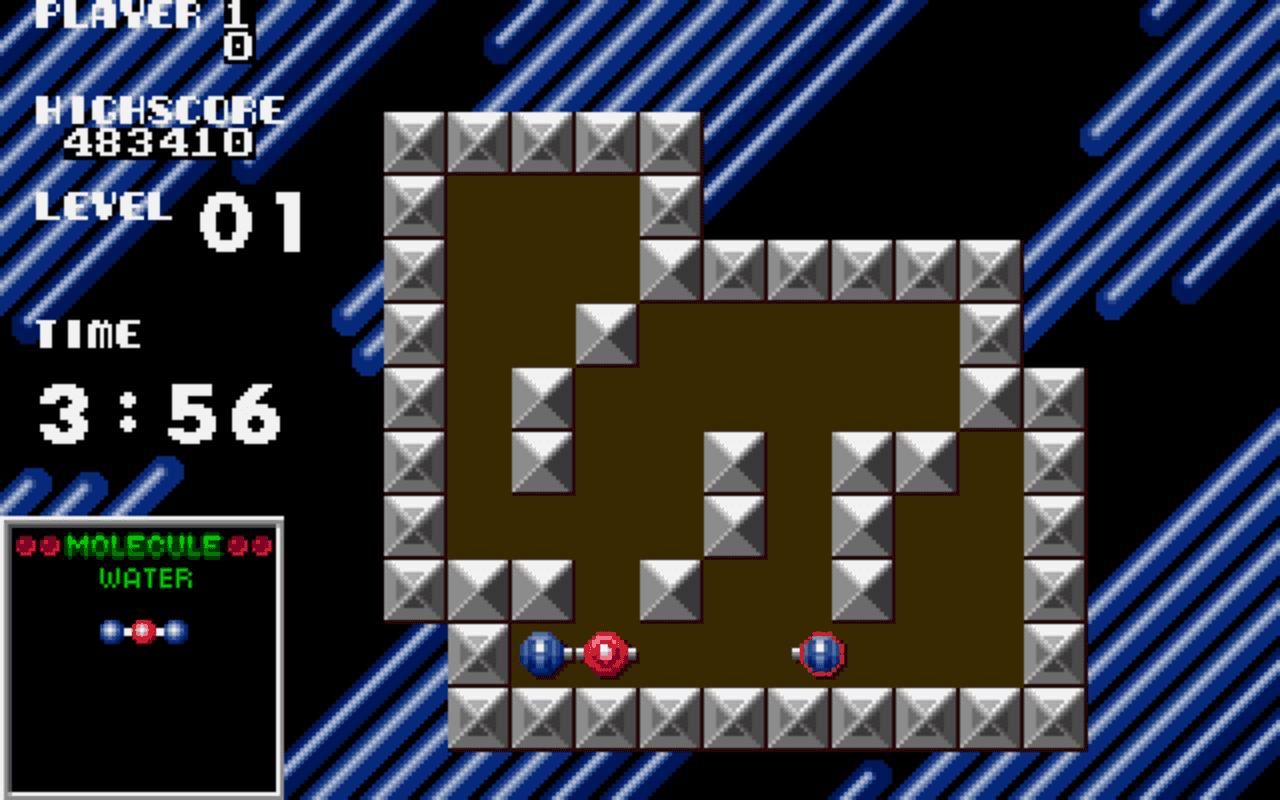
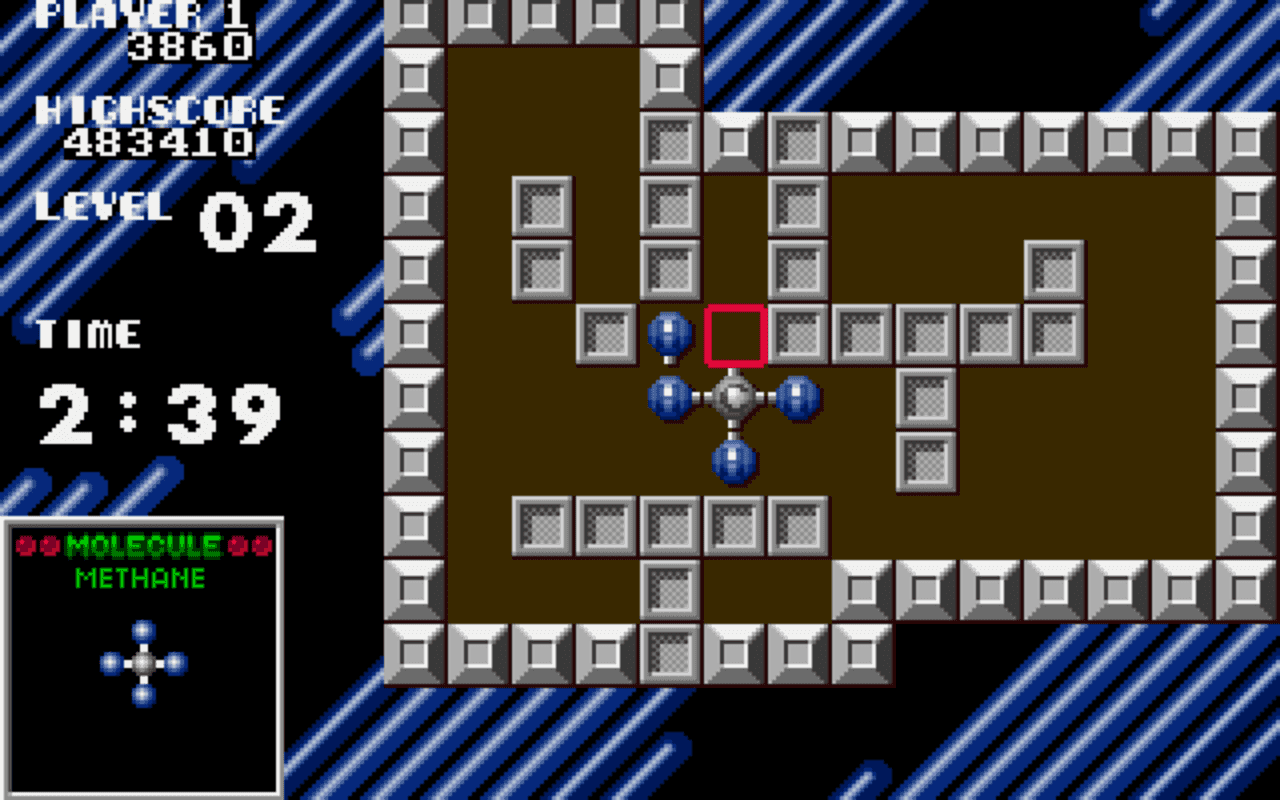
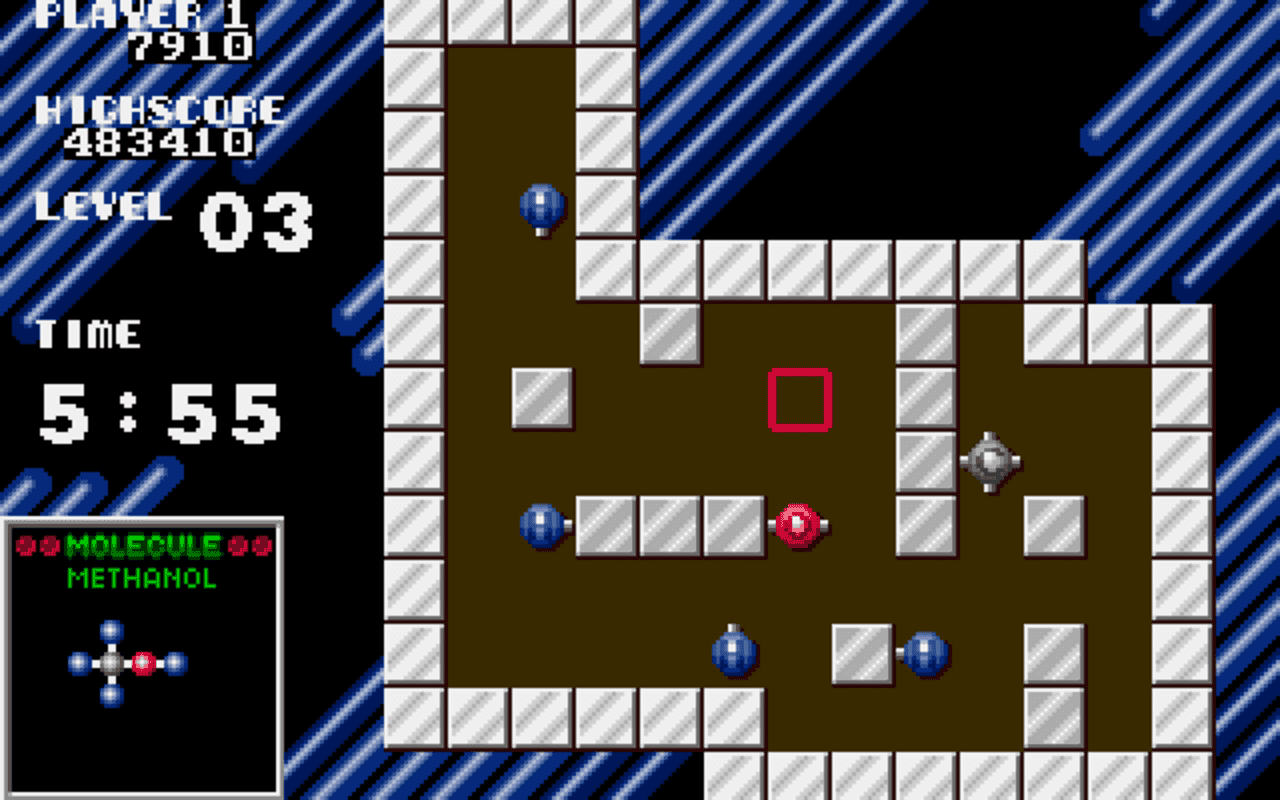
Each stage presents a blueprint of a target molecule and spreads the necessary atoms across a top-down grid filled with walls and corridors. The challenge is to move each atom so that, in the end, they match the pattern exactly. The catch lies in the way movement works: when you push an atom in one of the four cardinal directions, it slides in a straight line until it collides with a wall or another atom. That simple rule transforms each level into a kind of mental billiards table, where you are always thinking several moves ahead, trying to predict how one slide will affect the next.
Sliding atoms, tight timers and satisfying difficulty
Atomix grows steadily more demanding as you progress, but it never stops being fair. Early levels introduce basic molecule shapes and open layouts, giving you time to understand how atoms behave and how to use walls as anchors. Later puzzles tighten the available space and increase the complexity of the molecular patterns, forcing you to think in long sequences of moves rather than quick improvisations. The time limit on each level adds just enough pressure to keep you engaged without turning the experience into a frantic race.
Because the atoms can only stop when they hit something, a big part of the strategy is building temporary “stoppers” from other atoms. You might park one atom in a corridor, not because it is already in its final place, but because it will halt another atom later. Mistakes are rarely fatal right away, but a few misjudged slides can leave the board cluttered and awkward, so you quickly learn to visualize the final molecule before you make your first move. The game rewards patience and experimentation, and solving a tricky puzzle with seconds left on the clock feels uniquely satisfying.
Visually, Atomix keeps things clean and functional. The top-down view, clearly drawn atoms, and modest but charming animations all serve the gameplay. The interface focuses squarely on the grid and the molecule preview, so your attention stays where it matters. Audio tends to be understated and looping, providing a gentle backdrop that lets you concentrate on the logic at hand. In many ways, the presentation is a perfect match for a puzzle game that wants to be timeless rather than trendy.
Play Atomix online and rediscover retro logic
One of the reasons Atomix remains popular is how easily it fits into modern ways to play classic games. The straightforward controls and modest hardware demands make it an ideal candidate for browser-based emulation and other online setups. You can sit down and play Atomix online within moments, tackling a few molecule puzzles during a break or sinking into a long session of mental gymnastics.
Because the game is purely about thinking and sliding atoms on a 2D grid, it works well across different devices. It can be enjoyed on desktop computers in a standard browser window or on mobile devices with virtual keys or touch-friendly input, as long as you have precise directional controls. The gameplay does not rely on rapid action or pixel-perfect timing, so even on smaller screens you can comfortably study the layout, plan your path, and enjoy the slow burn of solving each level. Atomix also lends itself naturally to quick sessions: complete a molecule, feel that small victory, and step away—or dive into the next challenge. There are no artificial barriers or restrictions standing between you and the puzzles, making it a pure, free-feeling retro experience.
Why Atomix still matters for puzzle game fans
Atomix has endured because its core design is so strong. The idea of assembling real-world inspired molecules gives the puzzles a natural structure, and the sliding movement rule introduces surprising depth. You are not just shuffling pieces around; you are orchestrating a chain of interactions in a confined space, balancing the ideal molecular layout with the realities of the board. Players who appreciate games like Sokoban, The Incredible Machine, or other classic brainteasers will find similar pleasures here, but with a distinctive chemistry twist.
The game also has an educational side, even if it never advertises itself that way. By repeatedly building molecules from individual atoms, you get a casual sense of how structures are formed, which elements appear together, and how changing one connection can alter the entire shape. It is not a substitute for a textbook, of course, but it is a gentle introduction to thinking about atoms as parts of a larger pattern. The blend of learning and entertainment feels organic rather than forced, making Atomix a rare example of a puzzle game that can spark curiosity about science without sacrificing fun.
In terms of controls, Atomix keeps things intuitive. Typically, you move a cursor or selection highlight with directional keys, choose an atom, and then push it in the desired direction. The atom glides until it collides with something, and you repeat the process until the molecule is complete. Different versions may offer slightly different key layouts or shortcuts, but the fundamental feel remains identical across platforms. That consistency lets the design shine through, unaffected by shifting trends in input devices or interface conventions.
Atomix may look modest at first glance, with its simple graphics and quiet soundscape, but beneath the surface lies a rich series of logic challenges. Every level is like a self-contained puzzle box, and solving them one after another creates a steady rhythm of discovery and mastery. For fans of thoughtful gameplay, the game is a reminder that a strong idea and careful level design are enough to create something memorable, regardless of era or technology.
All codes used in Atomix are publicly available, and the game, its assets, and all related rights remain the property of its original authors and copyright holders.