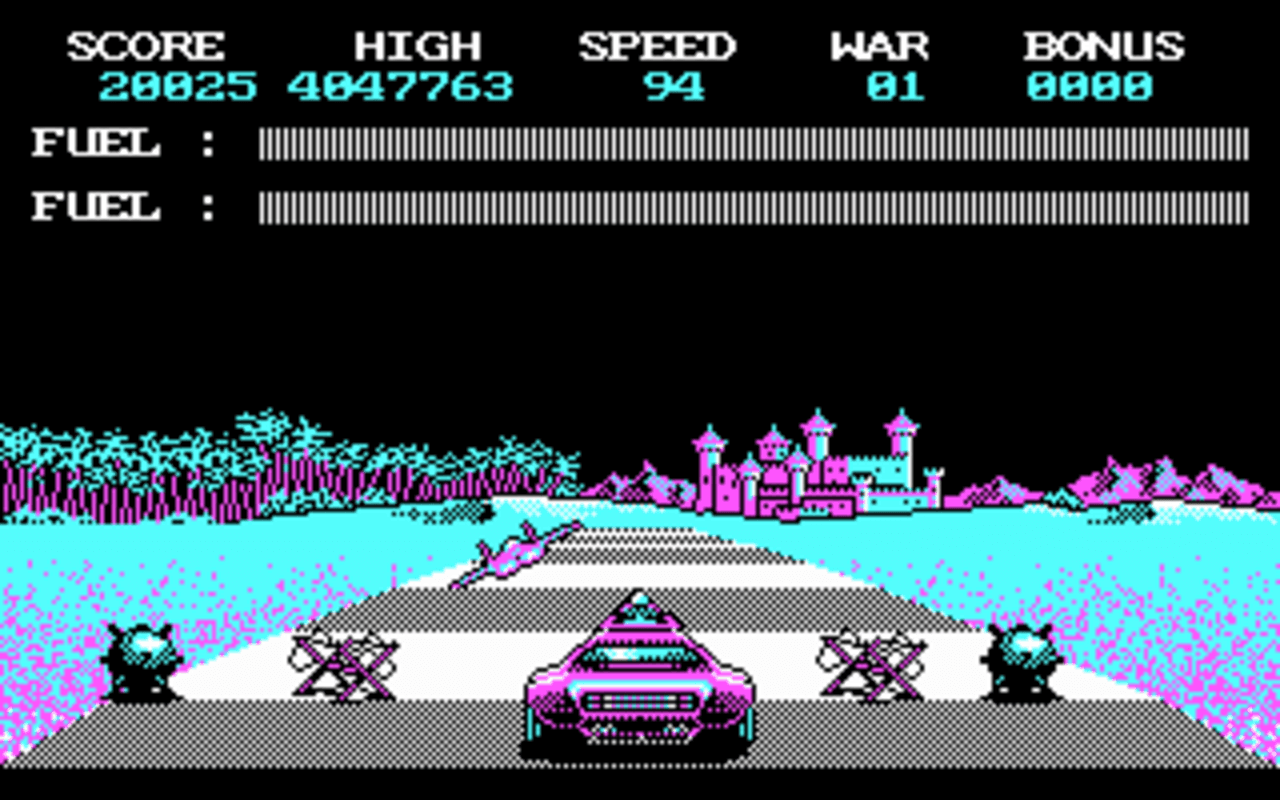
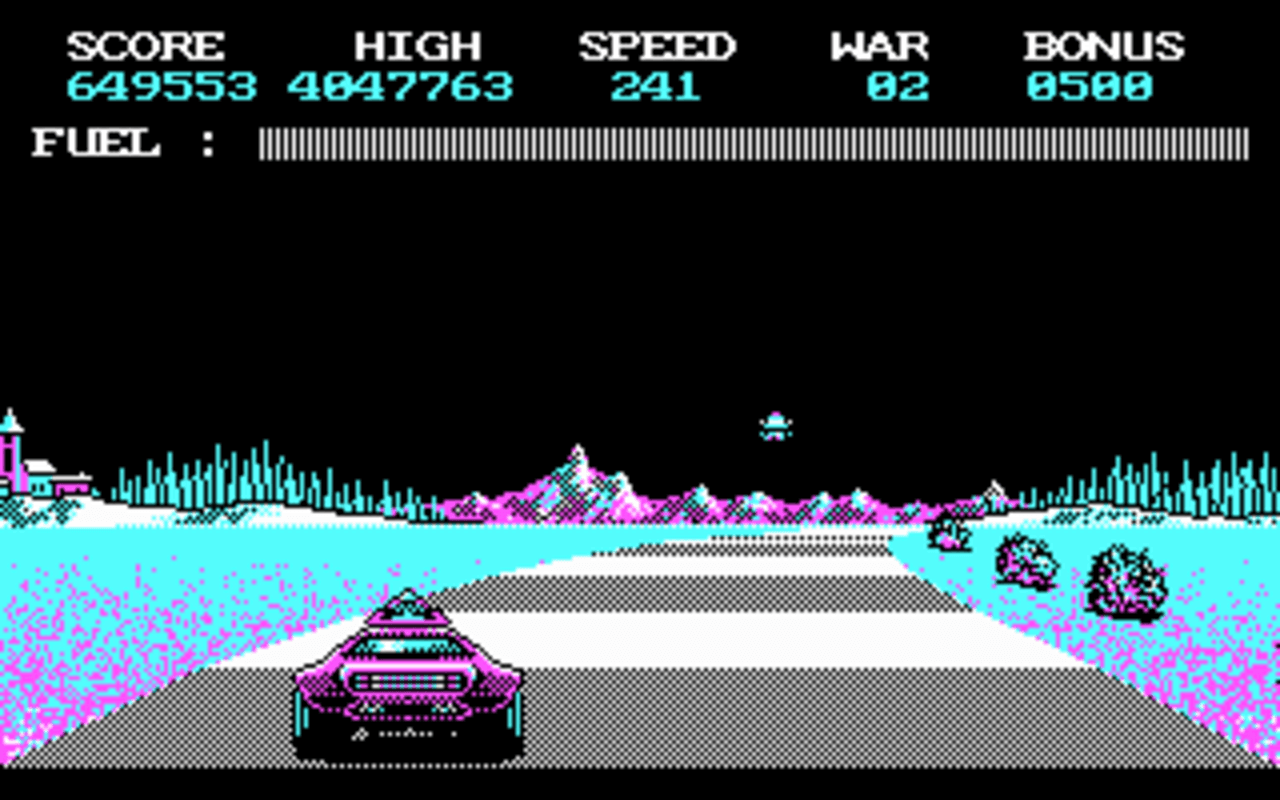
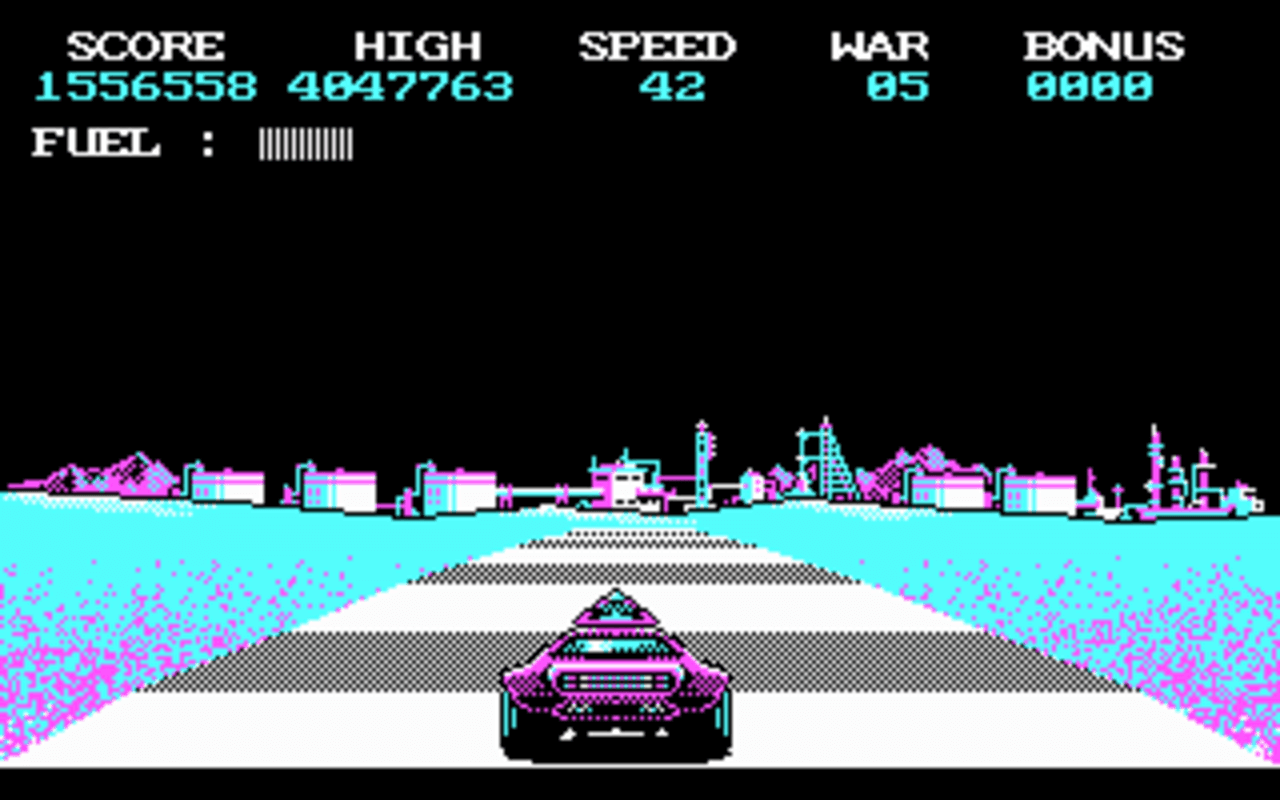
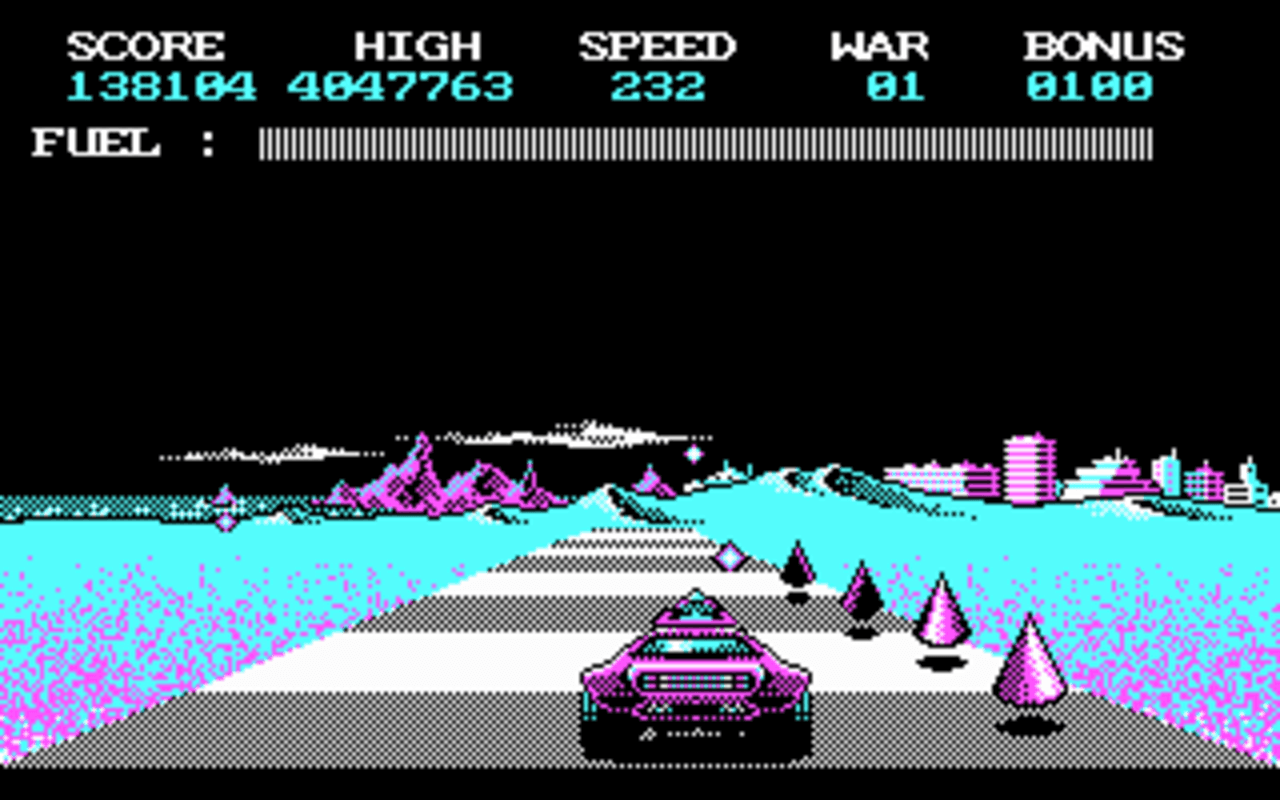
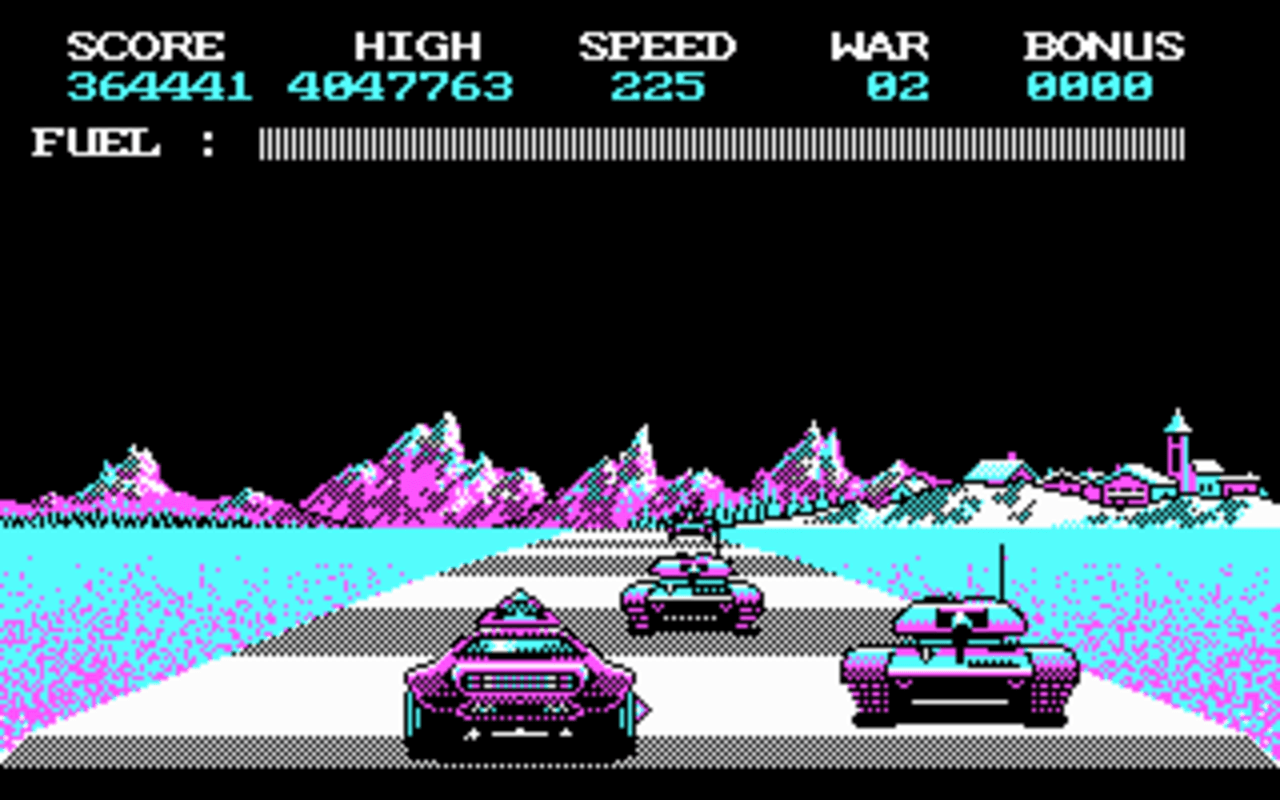
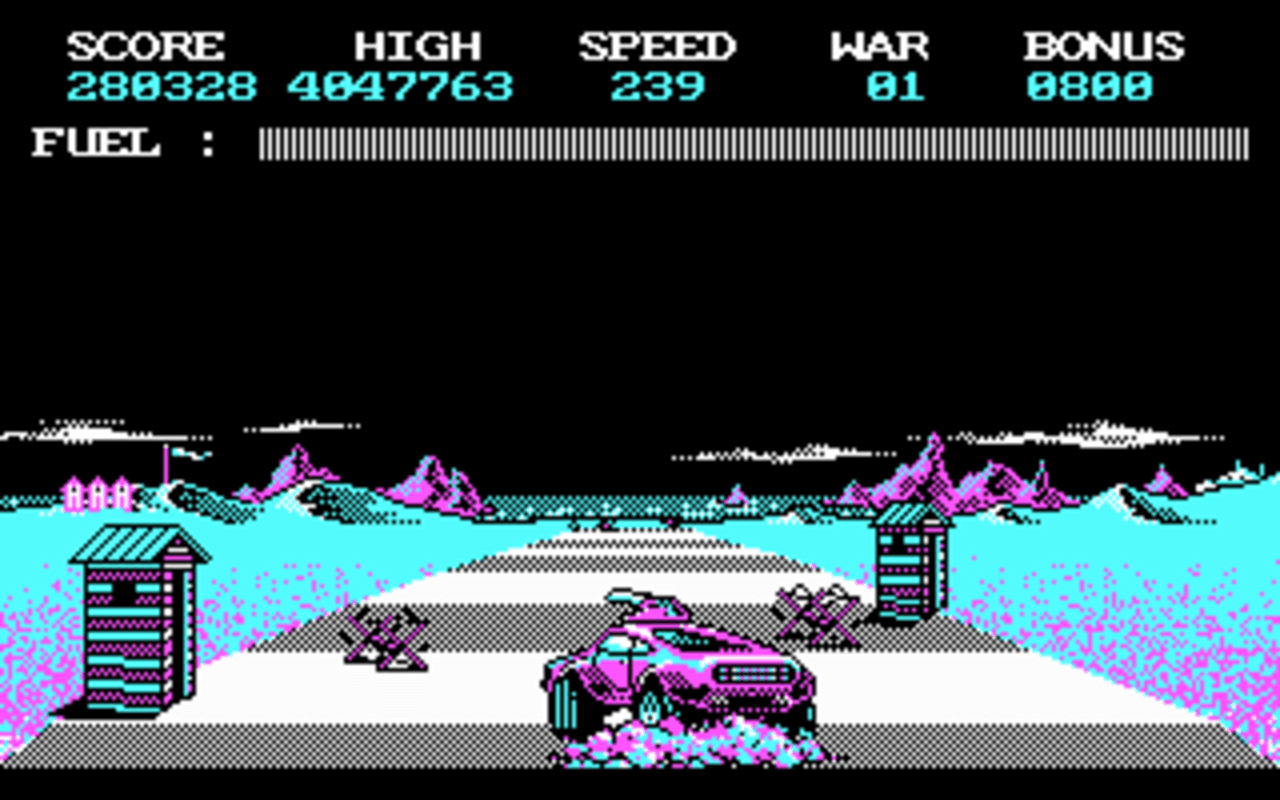
The game’s premise is simple but effective. As an elite driver in a heavily armed combat car, you are sent to “restore peace on earth” by hunting down enemy forces on global routes that circle the planet. The story stays mostly in the background, told through short bits of text and the bleak, war-torn visuals, but that is part of its charm. Fire and Forget feels like an arcade cabinet brought home, focused on immediate action rather than cutscenes or dialogue.
From a visual standpoint, Fire and Forget uses an over-the-shoulder perspective, giving you a view of the road stretching into the distance as traffic and enemies rush toward you. On DOS, the graphics are colourful yet gritty, with roadside objects, oncoming vehicles and the occasional helicopter or other foe crammed into the playfield. The sense of speed is strong, and the constant movement of sprites gives the impression of a crowded, dangerous highway. While it may not compete with later 3D racers, for its era it delivers a convincing feeling of velocity and chaos.
Driving, shooting and strategy in Fire and Forget
At its core, Fire and Forget is about juggling three things: driving, shooting and survival. Your car can accelerate hard, weave between lanes and fire a stream of projectiles at anything that dares to block your path. The controls are deliberately straightforward so that you can focus on reacting to threats. You speed along the road, trying to line up shots on enemy cars and motorcycles while still having enough space to dodge roadside obstacles, mines and incoming fire.
One of the defining mechanics is the fuel system. You have infinite lives, but when your fuel tank runs dry, the game is over, no matter how well you were doing. Fuel and power-ups appear along the road, forcing you to make quick decisions: do you risk threading through enemy fire to grab a fuel pickup, or do you play it safe and hope another appears later? This risk-reward loop keeps every run tense, particularly on higher difficulty levels where the road is crowded with hazards.
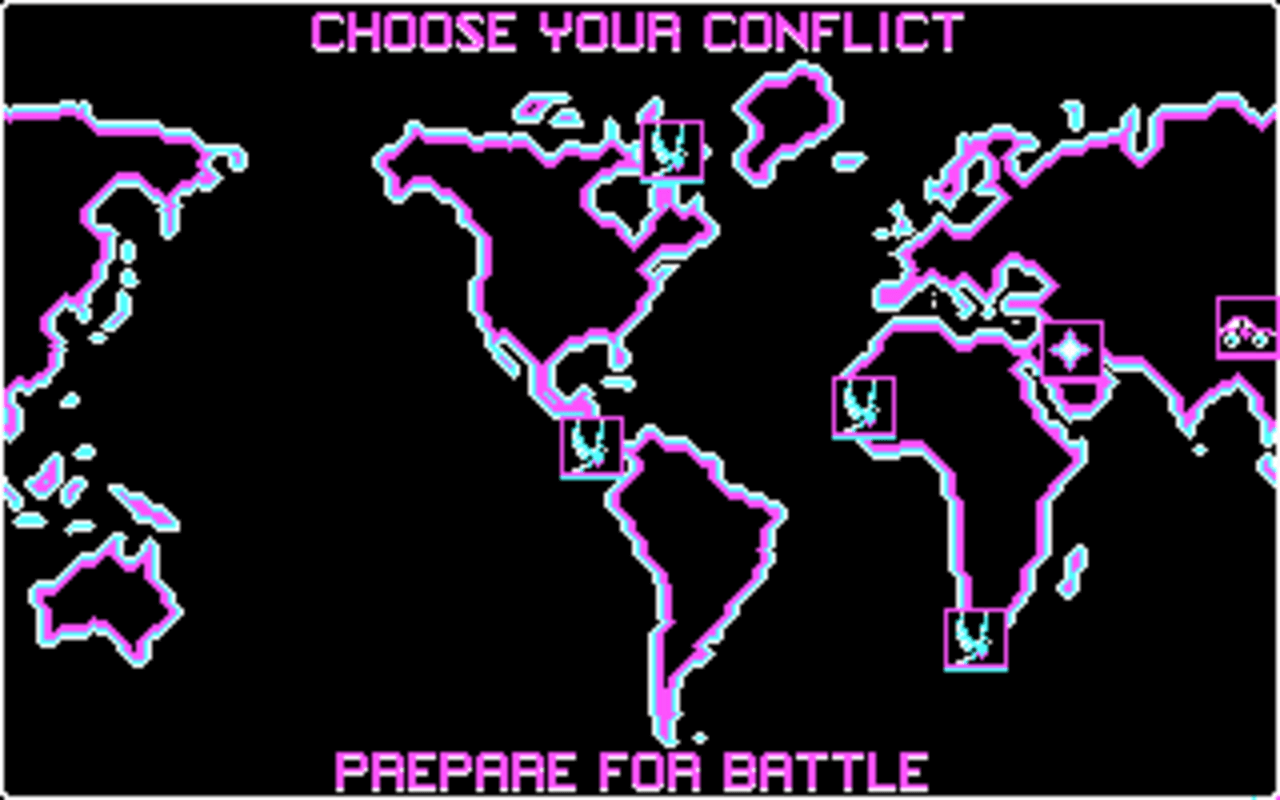
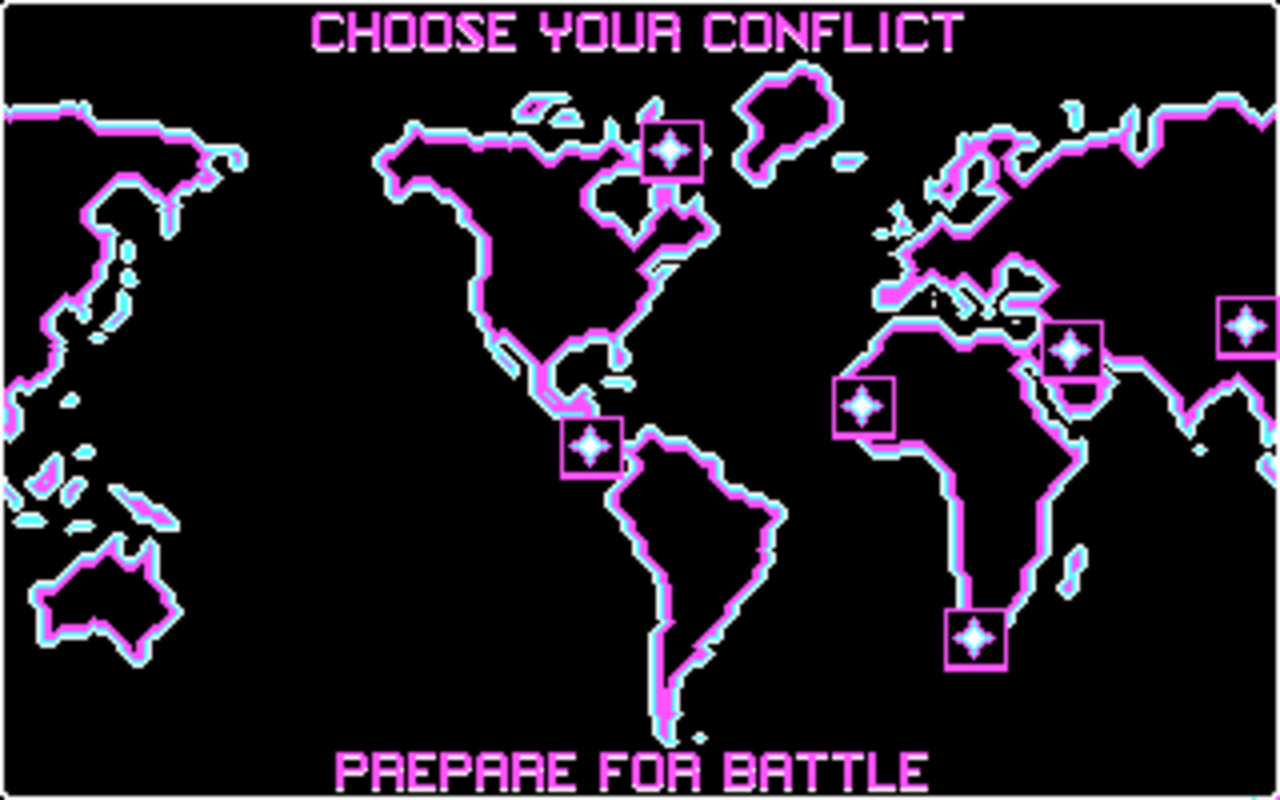
Each difficulty offers multiple courses around the world, effectively turning Fire and Forget into a global tour of danger. Although the scenery differences are mostly cosmetic, they give a sense of progression and variety as you advance. Enemies grow more aggressive, traffic density increases, and the room for error shrinks. Players who learn the layouts, enemy spawn patterns and pickup locations gain a significant edge over time.
For an action racing game, Fire and Forget is surprisingly tactical. You must manage speed carefully; racing flat out feels thrilling but can make it impossible to avoid collisions. Sometimes easing off the accelerator to thread through a tight cluster of enemies is the smarter move. You must also choose when to prioritize shooting over dodging: blasting an enemy in front of you can clear a safe path, but focusing too hard on firing can leave you blind to a sudden obstacle or a fuel canister flashing by on the roadside.
The appeal of Fire and Forget for arcade racing fans
Fans of classic arcade racers and vehicular combat games often appreciate Fire and Forget for its straightforward, old-school design. It is a score-chasing experience where each run can end in seconds if you misjudge a turn or miss a fuel can. That unforgiving nature gives it a “one more try” appeal that keeps you replaying course after course.
Compared with traditional racers of its time, Fire and Forget leans harder into pure arcade mechanics. There is no lap counter or racing grid; instead, your attention is locked on the horizon, scanning for enemies, pickups and roadblocks. The constant flow of opposition makes the game feel closer to RoadBlasters or later vehicular combat titles than to standard circuit racing. The combination of driving and shooting demands quick reflexes, making it ideal for players who enjoy a challenge rather than a relaxed cruise.
Audio-wise, Fire and Forget typically features energetic background music and punchy sound effects that emphasize explosions and collisions. The engine roar, gunfire and crash sounds all contribute to the sense of relentless motion. On systems with more limited audio, the soundscape may be simpler, but the game generally preserves that arcade atmosphere across its versions.
In terms of longevity, the game offers replay value through its difficulty levels and global routes. Reaching the end of all circuits in a single run without running out of fuel is a genuine accomplishment. Players who enjoy mastering patterns will find that, over time, they can predict where enemies spawn, when dangerous clusters of vehicles appear and where the most important fuel pickups lie. That mastery curve is where Fire and Forget truly shines, transforming what might at first feel chaotic into something almost rhythmic.
Play Fire and Forget online for free
Today, retro enthusiasts can often play Fire and Forget online through emulated versions that run directly in a browser window, recreating the DOS original without needing vintage hardware. Many such services allow you to start the game for free with a single click, keeping the experience as instant and accessible as an old arcade machine.
Because these online versions usually emulate keyboard or joystick input, they translate well to modern devices. On desktop or laptop computers, you can play Fire and Forget using simple keys to steer, accelerate and fire. On mobile devices, touch controls or on-screen buttons commonly replicate the original layout, letting you enjoy the same high-speed combat racing on the go. The game’s straightforward design, minimal menus and fast restarts make it particularly well suited to shorter bursts of play without restrictions on how many times you can jump back in.
For long-time fans, the ability to play Fire and Forget online in a browser is a nostalgic treat, bringing back memories of early PC gaming. For new players, it is a way to discover a classic action racing game without any technical setup. The mix of driving, shooting and fuel management remains instantly understandable, making this an easy retro recommendation for anyone curious about Titus’s early catalogue of games.
Why Fire and Forget still matters today
Even among many later vehicular combat games, Fire and Forget retains a special identity. It captures a particular moment in game design history, when developers were experimenting with combining racing and shooting while still operating within the technical limits of early PC hardware. By stripping the concept down to just a road, a car, enemies and a fuel gauge, Fire and Forget creates a pure, distilled arcade experience.
The game also offers a snapshot of Titus as a developer. Before later titles like Prehistorik and Titus the Fox expanded the studio’s reputation, Fire and Forget showed their interest in fast, visually striking action built around simple controls and aggressive difficulty. Seen from that perspective, playing Fire and Forget is not just revisiting a single game; it is stepping into the early years of a studio that would leave a memorable footprint on the world of classic games.
Modern players raised on cinematic racers may find Fire and Forget minimalist, but that minimalism is precisely what gives it enduring charm. There are no elaborate upgrade trees or story branches. Instead, you get tight, focused gameplay that rewards reflexes and pattern recognition. Each explosion, each last-second fuel pickup and each near miss on a crowded highway becomes its own small story, written in fractions of a second as you hurtle forward.
In practice, controlling Fire and Forget is intuitive. You steer the car left and right, control your speed, and use one or more buttons or keys to fire your weapons. Some versions also support joystick control, but the basic idea is always the same: keep the car moving, keep the enemies exploding and keep an eye on that fuel gauge.
Fire and Forget is a compact but demanding DOS action racing game that blends post-apocalyptic atmosphere, high-speed driving and continuous shooting into a timeless arcade-style experience. Controls are typically handled via simple directional input for steering and speed, plus an extra key or button for firing weapons, making the game easy to pick up even for newcomers to retro gaming. All used codes are publicly available, and the game belongs to its original authors.