Stryx and the Psygnosis Taste for Strange Futures
Psygnosis Limited built a reputation for bold, stylish worlds, and Stryx sits comfortably in that tradition as a late-era home-computer action game that refuses to stay in one lane. Instead of presenting a single “pure” genre, it blends platforming, light puzzle pressure, and arcade shooting into a roaming mission through a besieged sci-fi setting. The result is a game that feels like a restless experiment: sometimes rough, often surprising, and always committed to pushing you forward into the next odd scenario.
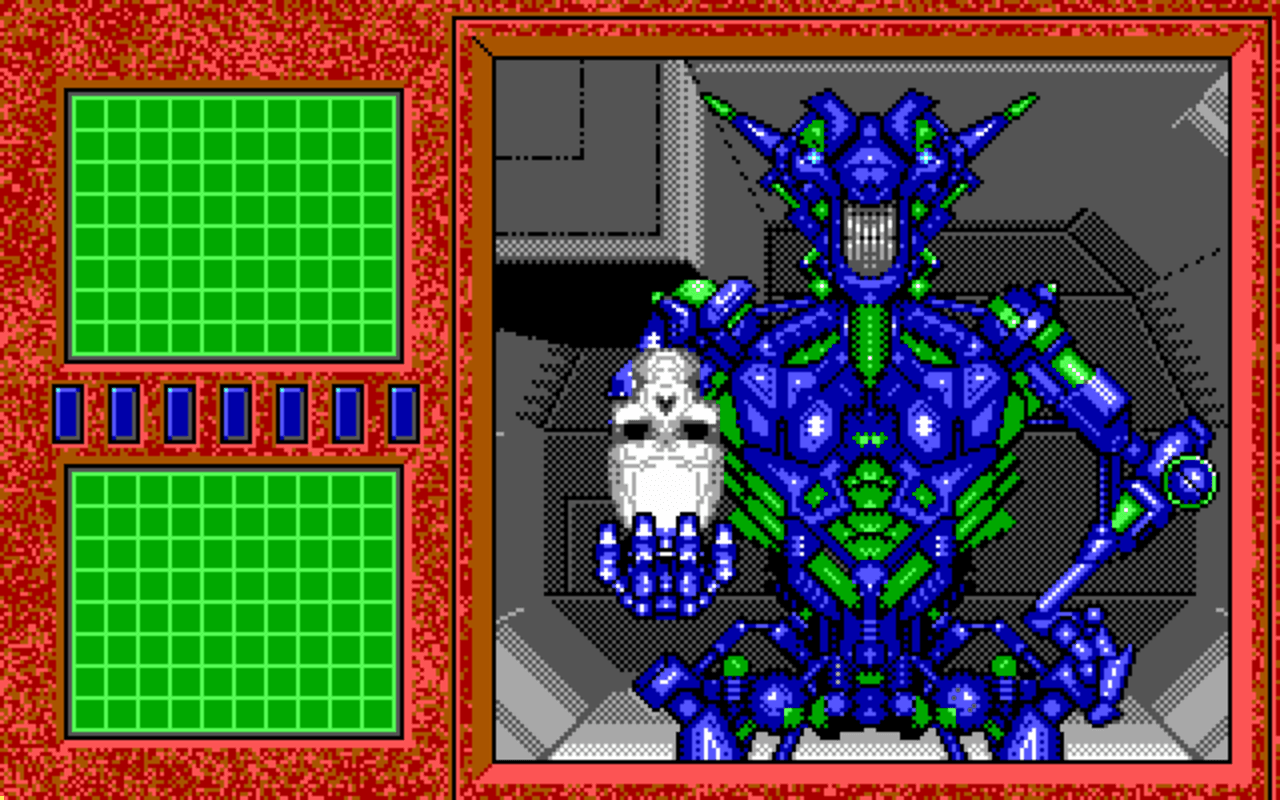
The premise is pulpy in the best retro way. You are Stryx, a cutting-edge cyborg operative deployed as a last-ditch answer to a cyborg threat. Your goal is to locate multiple keys that enable a termination system called “Lifeforce,” a drastic solution meant to wipe out robotic and computer systems, even at the cost of your own existence. That grim bargain gives the adventure a faintly tragic edge beneath the arcade chaos: you’re not just escaping a level, you’re advancing toward an ending that doesn’t pretend to be gentle.
Dome City Panic, Switching Vehicles, and Sudden Genre Swerves in Stryx
What most players remember about Stryx is its willingness to change shape midstream. One moment you’re on foot, inching through side-scrolling corridors and platforms; the next you’re riding a hovercraft or piloting a bizarre flying craft, and the game leans harder into shooting. This constant re-framing can feel unpredictable, but it also keeps the experience from becoming monotonous. When you play, you’re not settling into one rhythm for hours; you’re repeatedly asked to re-learn timing, spacing, and threat priorities.
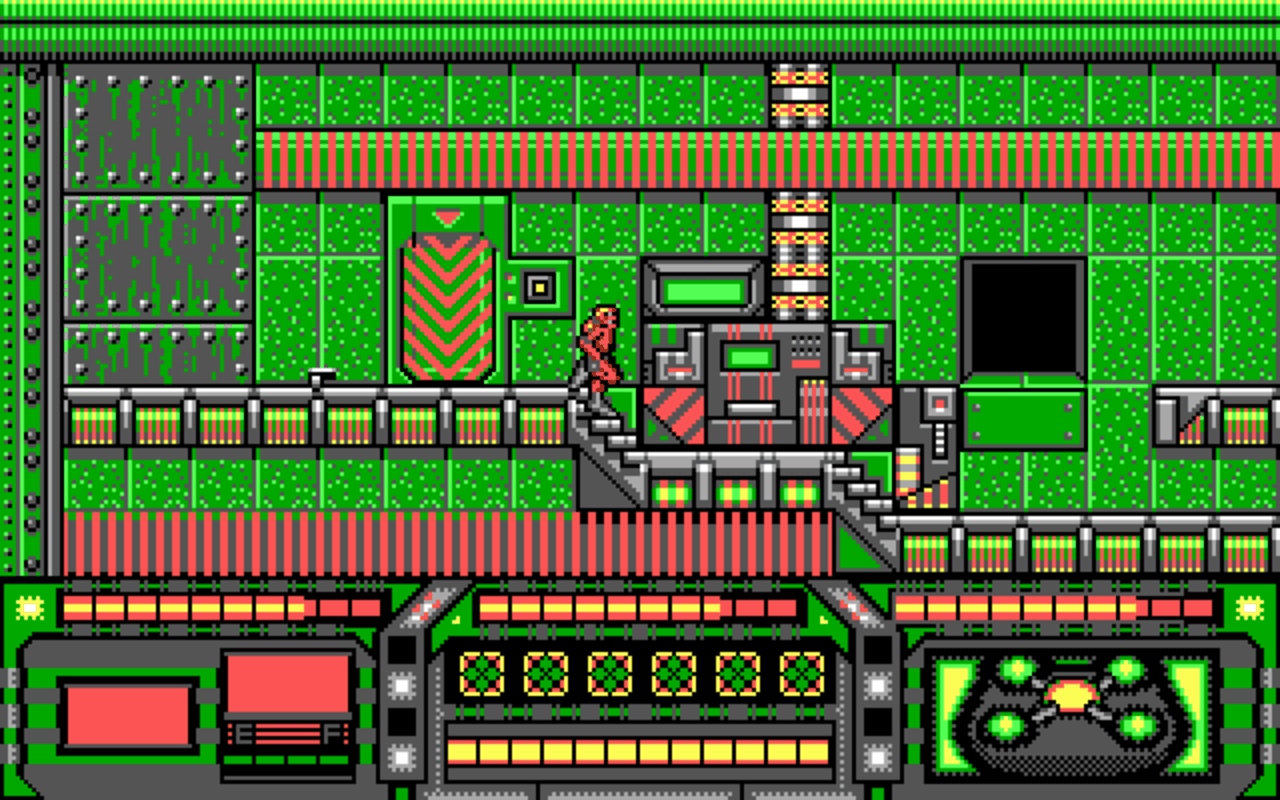
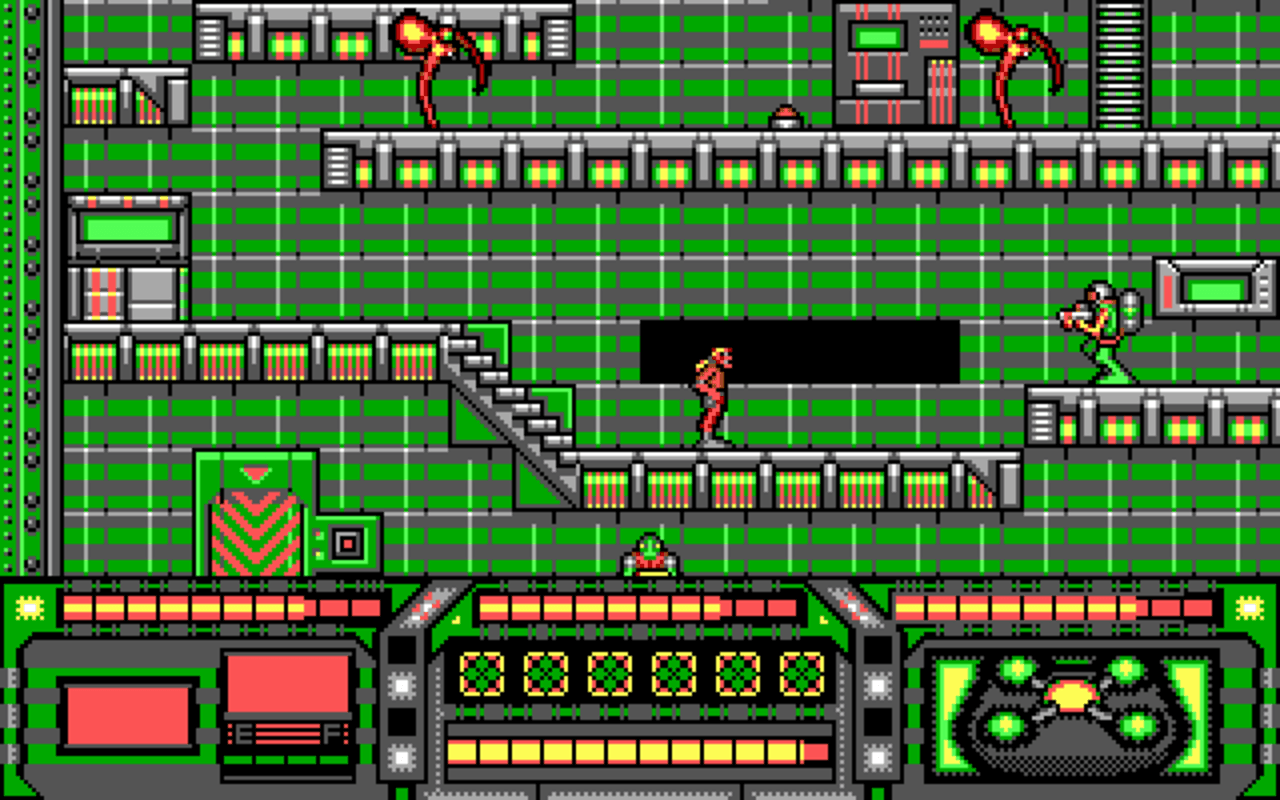
On-foot sections carry much of the “mission” feeling. You’re moving through enemy-held spaces that read like industrial sci-fi mazes, with hazards and awkward angles that punish sloppy movement. The gunplay isn’t about precision marksmanship so much as managing pressure: enemies take space away from you, and you respond by carving a safe lane to advance. When the game shifts into a shoot-’em-up posture, it becomes more immediate and reactive, asking you to track incoming patterns rather than navigate terrain.
That mix is why Stryx is easy to describe but harder to predict. It’s an action game, but it’s also a “sampler platter” of action sub-styles. Depending on your taste, that can be either the game’s charm or its provocation. If you enjoy classic DOS-era experimentation, Stryx offers that “what on earth is next?” feeling that many more polished titles ironed out.
Puzzle Tension and Combat Rhythm: How Stryx Creates Its Challenge
Stryx isn’t a pure platform shooter where you simply sprint and blast. Its levels often feel like they want you to look before you leap, testing patience as much as reflexes. The puzzle elements aren’t presented as separate “brain teaser rooms” so much as friction inside the flow: obstacles that demand you read the space, pick a safer route, or approach an encounter in a more deliberate order. That approach can be frustrating when you want nonstop speed, but it also gives the game identity. It turns progression into a small story of adaptation: you learn what kinds of trouble the game enjoys placing in your way, and you start anticipating it.
Combat, meanwhile, rewards controlled aggression. Because the game’s pacing shifts between exploration-like platforming and more straightforward shooting sequences, the best strategy is to treat every section as its own mini-discipline. In slower areas, your job is to preserve health and position, avoiding panic jumps and unnecessary trades. In faster segments, your job becomes pattern recognition and decisiveness, committing to safe lanes while still pushing forward. The game’s greatest trick is that it rarely lets you stay comfortable; it keeps nudging you out of whatever style you were just mastering.
It also helps that the story stakes, however minimal, create a sense of forward urgency. The Lifeforce objective frames each key you seek as part of a larger, irreversible plan. Even if you’re playing purely for mechanics, that narrative line adds a little weight to the constant movement: you’re not sightseeing in a sci-fi world, you’re racing toward a harsh solution.
Play Stryx online
If you want the classic experience without digging for old hardware, you can play Stryx online free, directly in a browser, and it also works on mobile devices without restrictions. The game’s quick-start arcade structure suits that format well: you can jump in, learn the current section’s rhythm, and keep pushing toward the next key objective. Because Stryx shifts between platform action and shoot-’em-up bursts, it’s especially satisfying for short sessions where you want variety without a long setup.
Why Stryx Still Earns a Spot in Retro Action Conversations
Stryx is not the neatest or most “modern-feeling” DOS action title, and that’s part of the appeal. It represents a moment when developers and publishers were still comfortable shipping unusual hybrids that didn’t fit a single clean label. Psygnosis Limited, sometimes associated with releases under the Psyclapse name, leaned into striking presentation and offbeat ideas across its catalog, and Stryx carries that same adventurous spirit.
As a review-style takeaway, the game shines when you embrace it as a changing obstacle course rather than a perfectly tuned run-and-gun. Its on-foot segments ask for care and persistence, while its shooting sequences deliver a more immediate arcade payoff. The story premise gives the mission a grim motivation, and the constant switching of play modes keeps the journey memorable even when individual moments feel sharp-edged.
In brief, Stryx remains a fascinating sci-fi action game to play online because it’s unpredictable, sometimes awkward, and frequently inventive. For controls, most versions follow classic PC action logic: move with the keyboard or directional inputs, jump with a dedicated key, and fire with another, with occasional context actions depending on the section you’re in.
All used codes are publicly available and that the game belongs to its original authors.